Sunday, March 11, 2012

Coaching Changes and Trust

First-order and second-order change "Big changes takes a lot of trust"
“First-order” change is change that is consistent with prevailing values and norms, meets with general agreement, and can be implemented using people’s existing knowledge and skills. This is the predominate coaching style which does not teach players how to learn or seek to improve the learning fundations. This is when coaches  manage around the technical skill of a player or works within their current  learning ability. A change process becomes “second-order” when it requires athletes to learn new approaches, or it  may conflict with their current processes, the framework of learning or situational norms. Second order change is a deep process and can disrupt people’s sense of well-being. But this is the type of change that is self sutaining. The second level of change requires growth on the part of those undertaking change, often discrediting existing schemas and frameworks. The more fundamental the changes sought by new ideas and influences, the greater the extent to which existing schemas must be restructured to form coherent understandings of the new ideas. This may confront and challenge expertise and competencies. An athlete who felt secure in their abilities as they were in the latter phases of learning “consciously competent” is now placed a step back and is now “consciously incompetent”. Those that require the most fundamental changes in behavior are the most difficult to change because they also require fundamental changes in their knowledge and learning structure. This change is likely to induce resistance as athletes find they must deal with a challenging sense of vulnerability

Before asking player to jump into the deep of learning a coach must be able to answer the following.
·         Does the coach understand the nature of knowledge and the student’s role in learning?
·         How do these ideas of knowledge and learning manifest in your teaching methods?
·         Does the coach have the theoretical knowledge allowing them to act upon principals?
·         Does the coach have the ability to teach at the pace of the learner?
·         Does the coach have the trust of the athlete?
  
 As the athlete is being challenged by a new learning method and dealing with new stresses one major key element the coach must possess is emotional intelligence. Referent power is the key to managing the emotions of stress in a player coach relationship. Referent power, as an aspect of personal power, becomes particularly important as organizational leadership is increasingly about collaboration and influence rather than command and control. Referent power is gained by a leader who has strong interpersonal relationship skills. Emotional intelligence is the key to leading and gaining trust.
      Emotional Intelligences: (coaches should master)
      Self-awareness: Self-aware people recognize and understand their own emotions. Self-awareness lays the foundation for the other domains.
      Self-management: Because they are attuned to their inner feelings, self-aware leaders are able to manage them. For example, they are able to control their temper.
Social awareness: Social awareness includes the ability to empathize with others, allowing leaders to understand the appropriate thing to say or do in the moment and to sense the shared values and priorities that drive a group. “Empathy, which includes listening and taking other people’s perspectives, allows leaders to tune in to the emotional channels between people that create resonance. And staying attuned lets leaders fine-tune their message to keep it in synch
Relationship management: Leaders who understand their own vision, values, and emotions and who are attuned to those of the group can then use their relationship management skills to catalyst resonance

Tuesday, February 21, 2012

If your preventing problems, sometimes your really not helping!

Parents I have seen three times in one year kids have panic attacks on the volleyball court when things were not going well in their performance. I also know these kids and they have helicopter parents who try to prevent there kid from having to deal with anything. I have also found that kids have a crushing paralysis when I comes to dealing with the challenges in their own skills or strategies. Most don't want to here what they need to do to improve and they don't want to figure out the corrections with guidance. They want to be told they are great, get a little advice so long as it doesn't tell them the real negatives, and then they expect a quick fix. Kids need to be taught to apply them selves despite adversity and that any thing worth having is not easily earned. Here is a great article to articulate what a problem this has become. Click Here, Thanks for lead Nik

Saturday, February 18, 2012

Setter foot work:

The objective is to be able to set from pin to pin with a perfect or non-perfect pass. In short from anywhere to anywhere. At any tempo would be nice but that really comes down to your personnel and probabilities. There are also some options that are going to allow the hitter to create their own shot and help reduce setter errors. Like setting a high safe ball at 5x5 (five feet off the net and five feet in from the side line) from a bad pass allows the hitter to do the work of scoring.

Lets talk about non-perfect pass footwork:
Foot work is the key to making work. By starting from an open position (shoulders and hips open to the passers) taking and taking split step as the ball is contacting the passers arms greatly increases the setters ability to get to almost any ball. From the open position  and split step the setter can get to balls passed out over the front of their right shoulder by going (Right, Left, Right,) and balls passed towards the right side line that are out over the left shoulder with (Left, Right, Left) If the setter is unable to get both feet down and set squared to the left side, the setter can pivot of the last step as they make contact with the ball while squaring to the left side. Here are few examples pay attention to the setter in white.
 Here is a good Right Left Right and it gets set to a front row hitter who makes a great shot high over the block


The first set in this clip has poor footwork with the setter drifting into the net. The second set is the one to pay attention to.  Right Left Right Foot work

A nice Spin Set

Left Right Left

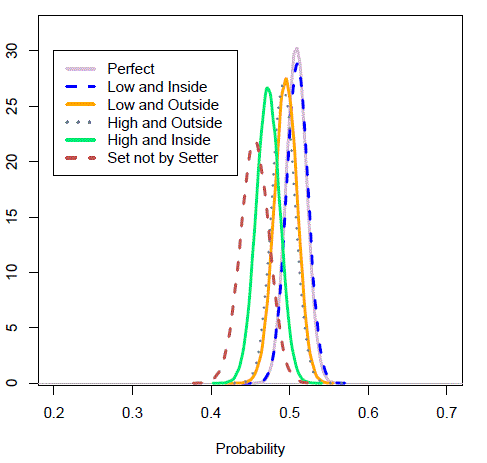
Setting location, distance, and depth as the keys to a setters strategy when dealing with non-perfect passes. The objective is to score, so what height, what distance off the net and how wide or inside should you set to score the most points. Here are a few graphs from the a study by Gil Fellingham to help you make those choices. The show how high the probability is for the ball to be killed depending on the three dimensions mentioned.

                                                Distance off the net

Height & Distance of set
Who it gets set to

Thursday, February 9, 2012

There is no "I" in Coach

Coaching is the artful balance of teaching, leading, and managing. That being said where do you begin trying to improve your self as a coach. At City Beach we rank leadership as the highest valued skill set a coach can have. Leadership is the lynch pin of the three. Knowledge of the game and teaching methods are highly important around here but it is all for not if players won't listen to you. A player has to know that your actions are for their benefit not your own. It is only then that they will trust you and only then can they find their own motivations to improve.

Here is a great clip from the Harvard Business Journal about leadership (click here) and it would appear that the greatest failing of leadership is the leaders own ego, and the faulty path taken by those who are self centered.

Sunday, February 5, 2012

Improving your game

We often her about how someone is a natural athlete which odd since science has proven repeatedly that doesn't exist.  I sometimes her about how two players should be put on team together because they were on the same school team, club teams, and they had the same coaches. This logic is usually motivated by folks that are uniformed, or are just being to hyper about their child's self esteem, or how the family looks. No two kids will have the same amount of benefit from a coach, it's not possible. Its not the coaches fault it's the fact that the kids are individuals that causes this. Two brother from the same family can me very close together in age but yet have totally different perceptions of life growing up. The point being is that no one can account for what a player was thinking. Most of the kids are hearing identical messages 90% of the time, but in the end one will have improved more because they made better use of their own thoughts. Two kids can be set the same slight out of position ball. Player A thinks about how to handle the bad situation better next time and Player B is thinking about how it's the setter fault. Learning from feedback and learning from mistakes makes all the difference. A growth minds set can helps players be much more productive.

Follow this link for a clue into why people learn differently  CLICK HERE

How to be growth minded

Thursday, January 12, 2012

Ball Control

Volleyball is a great game when it is played off the net. Observe the ball control in this amazing rally. Nothing is over passed or over dug. They run the middles and every hitter from 4-9 feet off the net. Its only when a hitter tries the ill advised low seam shot against a solid double block that the rally ends. Enjoy the hustle and ball control. It's statistics if you can keep your median pass off the net the balls that are not perfect are still on your side. When I first got to City Beach I had a team that lost by 2 or 3 points all the time. They also targeted passes right to the net and they over passed/dug 5-11 balls in those losses. What if we got to hit those balls instead of the other team.

Wednesday, November 16, 2011

Locus of Control

I recently learned about how to take the first step in becoming a person who is ready to change and grow. This first step requires a change in your emotions and logic at the same time.  Learning requires that we take responsibility for our actions. We have to stop blaming others when we are unsatisfied.

What are the forces that make a player successful or unsuccessful? What or who is responsible for reaching a goal or the failure to achieve a goal? Answer: You are. When coaching there is only one way to motivate a kid. We have to do our job and teach kids they are empowered and successful results are earned. At City Beach we train players that the Locus of Control is internal. We coach from a cause and effect perspective, your action will directly equal your results. This mean that the player has just as much responsibility as the coach.

Locus of control
is a theory in personality psychology referring to the extent to which individuals believe that they can control events that affect them. Understanding of the concept was developed by Julian B. Rotter in 1954, and has since become an important aspect of personality studies.
One's "locus" (Latin for "place" or "location") can either be internal (meaning the person believes that they control their life) or external (meaning they believe that their environment, some higher power, or other people control their decisions and their life). Individuals with a high internal locus of control believe that events result primarily from their own behavior and actions. Those with a high external locus of control believe that powerful others, fate, or chance primarily determine events.


So what or who do you believe is in control? Test your perspective click here

Here are a few quotes we like:

Put your future in good hands - your own  ~Author Unknown
I was thinking of my patients, and how the worst moment for them was when they discovered they were masters of their own fate.  It was not a matter of bad or good luck.  When they could no longer blame fate, they were in despair ~Anaïs Nin

Without a humble but reasonable confidence in your own powers you cannot be successful or happy.  ~Norman Vincent Peale

Do your thoughts serve you well? ~ Jim McLaughlin
It took me a long time not to judge myself through someone else's eyes.  ~Sally Field

It's not who you are that holds you back, it's who you think you're not.  ~Author Unknown


Whether you think you can or think you can't - you are right.  ~Henry Ford

Confidence comes not from always being right but from not fearing to be wrong.  ~Peter T. Mcintyre

Our doubts are traitors, and make us lose the good we oft might win, by fearing to attempt.  ~William Shakespeare